Thursday, July 14, 2011
2SDS #1-6, p. 204
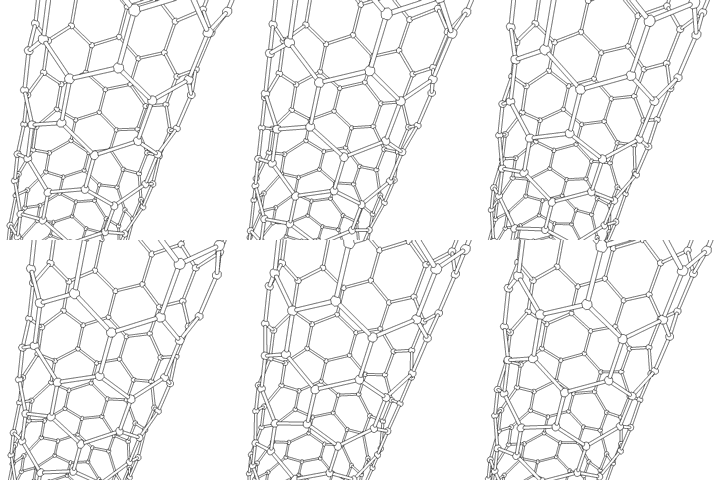
1) What is an allotrope?
An allotrope is a different form of an element that has distinctly different physical or chemical properties.
2) Name two elements other than carbon that form allotropes.
Oxygen, silicon, and phosphorus form allotropes as well.
3) A diamond, a chunk of coal, and your pencil lead contain the same substance:
a. How are their properties different?
b. Why are their properties different?
c. What accounts for the differences in the cost of these items?
a. A diamond is the hardest substance known, not electrically conductive, has an extremely high melting point, and is rare; therefore, it is very expensive. Coal is very combustible and cheap. Pencil lead, made of graphite, is a useful lubricant, a conductor of electricity, extremely soft, and very common and cheap.
b. Their properties are different because although they are made of the same element, they are allotropes of carbon, and therefore, have very different atomic arrangements.
c. The rigid, three dimensional structure of carbon atoms in diamonds indicates its high melting point, hardness, and rareness that accounts for its high cost. The atomic makeup of graphite and coal indicate their much more common, more reactive, and softer properties, and therefore, their cheaper prices.
4) How do engineered materials differ from natural materials?
Engineered materials are materials developed by scientists and engineers to enhance natural materials through manufacturing methods that carefully control the microstructure of the materials; the makeup of natural materials, however, is uncontrolled and untouched.
5) List two advantages and two disadvantages of using engineered ceramics in high-temperature applications.
Ceramics are durable and have high melting points and strength at high temperatures. However, ceramics are also brittle and when rapidly exposed to high and low temperatures, will crack.
6) Describe two examples of properties that can be modified in plastics to make them useful for new applications.
Plastics can be customized to be either soft or hard. For example, polyethylene can be tailored to display soft properties, such as a squeeze bottle for water, or tailored to be hard and brittle, like glass. Plastic can also be made into optical fibers, which replace copper wires and provide fantastic and noise free communication systems with high capacities.
2SCS #18-21, p. 182
18)
a. What is the difference between reusing and recycling?
b. Give two examples of each, other than those presented in the textbook.
a. Reusing is the use of the same item multiple times for the same, or different tasks the item is applicable to. Recycling is when an item is reprocessed into a a different item made of parts, or all of the same substances.
b.
Reusing: water bottles, plastic containers, paper.
Recycling: Cans, paper, glass, plastic.
19) In addition to those found in the textbook, list four examples of
a. renewable resources.
b. nonrenewable resources.
a. fertilizer, water, air, soil, water, plants, animals.
b. platinum, gold, silver, petroleum, copper, natural gas, coal.
20) Classify each use as either recycling or reusing:
a. storing water in used juice bottles for an emergency.
b. converting plastic milk containers into fibers used to weave clothing fabric.
c. packing breakable items with shredded newspaper.
a. reusing.
b. recycling.
c. reusing.
21) How would the life cycle of a light bulb compare to that of a newspaper? Consider material sources and disposal and recycling.
Both glass from a light bulb and paper from a newspaper can be recycled. In fact, since paper that is not recycled leaves a high proportion of combustibles as waste, the newspaper can be sent to a waste-to-energy plant to produce energy that can be used to power the light bulb.
Extra Credit for Friday, July 14th: Laser-emitting cells: A healthy glow: Jun 15th 2011, 12:47 by T.C.
Laser-emitting cells
A healthy glow
Jun 15th 2011, 12:47 by T.C.
Ever since the laser was invented in 1960, lasers have become stable for vast amounts of uses. A group of scientists led by Dr. Seok-Hyun Yun at Harvard Medical School have created a laser from a biological cell. In order to work, a laser needs a lasing medium, that amplifies externally-supplied light, and an optical cavity, which bounces the light back and forth through the medium in order to achieve desired power. Although normally lasers are composed of media such as crystals doped with rare-earth elements, mixtures of gas, and even certain sorts of semiconductors, Dr. Yun designed his new version of a laser with a chemical called Green Fluorescent Protein (GFP). GFP is not only a well-known chemical that is used to keep track of particular proteins and gene sequences, but is also the substance that makes certain species of jellyfish glow in the dark. With the motive of creating a mind-blowing, yet practical technology that could lead to less-risky lasik surgeries and procedures, Dr. Yun began an experiment of programing GFP into human cells. Dr. Yun and his team of scientists genetically engineered a human embryonic kidney cell to produce GFP, and, since lasers are essentially composed of many little mirrors, placed the cell between two tiny mirrors to form a minuscule optical cavity. When they shone pulses of light at the cell programed to produce GFP, it duly produced a “beautiful green” laser beam. More impressively, this light was detectable by the naked human eye! In order to progress with his motive of using this internally programed laser for practical medical uses, such as removing tattoos, correcting short-sightedness, cutting tissue, and whitening teeth, Dr. Yun plans to integrate the optical cavity into the cell itself, removing the need for any external equipment besides a light source that will activate the internal laser beams. With the success of this development, lasers will be generated internally, by a patient’s own cells. Although cynics are skeptical and unsupportive of this creative development, if equipping the cells with optical cavities and then pumping them to produce a laser beam is achieved, laser treatments will be much cheaper, easier, and safer than traditional treatments that require the purchase of off-the-shelf medical lasers from factories in China. This could very well be the achievement that leaves children and adults all over the world "infused" with a passion for science.
http://www.economist.com/blogs/babbage/2011/06/laser-emitting-cells
A healthy glow
Jun 15th 2011, 12:47 by T.C.
Ever since the laser was invented in 1960, lasers have become stable for vast amounts of uses. A group of scientists led by Dr. Seok-Hyun Yun at Harvard Medical School have created a laser from a biological cell. In order to work, a laser needs a lasing medium, that amplifies externally-supplied light, and an optical cavity, which bounces the light back and forth through the medium in order to achieve desired power. Although normally lasers are composed of media such as crystals doped with rare-earth elements, mixtures of gas, and even certain sorts of semiconductors, Dr. Yun designed his new version of a laser with a chemical called Green Fluorescent Protein (GFP). GFP is not only a well-known chemical that is used to keep track of particular proteins and gene sequences, but is also the substance that makes certain species of jellyfish glow in the dark. With the motive of creating a mind-blowing, yet practical technology that could lead to less-risky lasik surgeries and procedures, Dr. Yun began an experiment of programing GFP into human cells. Dr. Yun and his team of scientists genetically engineered a human embryonic kidney cell to produce GFP, and, since lasers are essentially composed of many little mirrors, placed the cell between two tiny mirrors to form a minuscule optical cavity. When they shone pulses of light at the cell programed to produce GFP, it duly produced a “beautiful green” laser beam. More impressively, this light was detectable by the naked human eye! In order to progress with his motive of using this internally programed laser for practical medical uses, such as removing tattoos, correcting short-sightedness, cutting tissue, and whitening teeth, Dr. Yun plans to integrate the optical cavity into the cell itself, removing the need for any external equipment besides a light source that will activate the internal laser beams. With the success of this development, lasers will be generated internally, by a patient’s own cells. Although cynics are skeptical and unsupportive of this creative development, if equipping the cells with optical cavities and then pumping them to produce a laser beam is achieved, laser treatments will be much cheaper, easier, and safer than traditional treatments that require the purchase of off-the-shelf medical lasers from factories in China. This could very well be the achievement that leaves children and adults all over the world "infused" with a passion for science.
http://www.economist.com/blogs/babbage/2011/06/laser-emitting-cells
Wednesday, July 13, 2011
2SCS #13-17, p. 181
13) For the equation
3 PbO(s) + 2 NH3(g) --> 3 Pb(s) + N2(g) + 3 H2O(l)
a. how many moles NH3 are needed to react with 9 mol PbO?
b. how many moles N2 are produced by the reaction of 10 mol NH3?
c. how many moles Pb are produced from 5 mol PbO?
a. 6 moles NH3 are needed to react with 9 mol PbO.
b. 5 moles N2 are produced by the reaction of 10 mol NH3.
c. 5 moles Pb are produced from 5 mol PbO.
14) For the equation in Question 13,
a. how many moles (maximum) N2 can be produced from 34.0 g NH3?
b. what mass Pb can be produced from the complete reaction of 3.0 mol PbO?
c. what maximum mass N2 can be produced from 34.0 g NH2?
d. What mass PbO, which fully reacts, will produce 415 g Pb?
a. 1 mol N2 can be produced from 34.0 g NH3.
b. 621 g Pb can be produced from the complete reaction of 3.0 mol PbO.
c. 28 g N2 can be produced from 34.0 g NH2.
d. 415 g PbO, which fully reacts, will produce 415 g Pb.
15) In carbon dioxide, two-thirds of the atoms are oxygen atoms; however, the percent oxygen by mass is not 67%. Explain.
Although the percent of the oxygen atoms is 67%, since oxygen's molar mass is 32 and carbon's molar mass is 12 in this molecule, The percent oxygen by mass 32g/44g x 100%, or 73%.
16) Find the percent metal (by mass) in each of the following compounds:
a. Ag2S
b. Al2O3
c. CaCO3
a.
molar masses: Ag, 216g; S, 32g
216+32=248. 216g/248g x 100%=
87% silver by mass
b.
molar masses: Al, 54g; O, 48g
54+48=102. 54g/102g x 100%=
53% aluminum by mass
c.
molar masses: Ca, 40g; C, 12g; O, 48g
40+12+48=100. 40g/100g x 100%=
40% calcium by mass
17) A 50.0-g sample of ore contains 5.00 g lead(II) sulfate, PbSO4:
a. What is the percent lead (Pb) in PbSO4?
b. What is the percent PbSO4 in the ore sample?
c. What is the percent Pb in the total ore sample?
d. Use a diagram to represent the proportions of lead and lead(II) sulfate in the ore.
a.
molar masses: Pb, 207g; S, 32g; O, 64g
207+32+64=303. 207g/303g x 100%=
68% lead by mass
b.
5g/50g x 100%=
10% PbSO4 in the ore sample.
c.
68 x .10=
6.8% Pb in the total ore sample.
d.
Tuesday, July 12, 2011
2SCS #1-12, p. 180
1) State the law of conservation of matter.
The law of conservation of matter is that matter is neither created nor destroyed.
2) What is a scientific law?
Scientific law summarizes what has been learned by careful observation of nature.
3) Why are expressions such as "using up" and "throwing away" misleading, if the law of conservation of matter is taken into account?
Expressions such as "using up" and "throwing away" are misleading because according to the law of conservation of matter, molecules can be converted and decomposed by chemical processes, but atoms are forever, and are not "used up" or "thrown away."
4) Complete atom inventories to decide if each of these chemical expressions is balanced.
a. the preparation of tin (II) fluoride, a component of some toothpastes (called stannous fluoride in some ingredient lists):
Sn(s) + HF(aq) --> SnF2(aq) + H2(g)
b. the synthesis of carborundum for sandpaper:
SiO2(s) + C(s) --> SiC(s) + CO(g)
c. the reaction of an antacid with stomach acid (hydrochloric acid):
Al(OH)3(s) + 3 HCl(aq) --> AlCl3(aq) + 3 H2O(l)
a. Not balanced.
Reactant side: Sn, 1; H, 1; F, 1
Product side: Sn, 1; H, 2; F; 2
b. Not balanced.
Reactant side: Si, 1; O, 2; C, 1
Product side: Si, 1; O, 1; C, 2
c. Balanced.
Reactant side: Al, 1; O, 3; H, 6; Cl, 3
Product side: Al, 1; O, 3; H, 6; Cl, 3
5) Consider this equation: N2(g) + 3 H2(g) --> 2 NH3(g)
a. What is the coefficient for hydrogen gas?
b. What is the coefficient for NH3 gas?
c. What is the coefficient for nitrogen gas?
a. The coefficient for hydrogen gas is 3.
b. The coefficient for NH3 gas is 2.
c. The coefficient for nitrogen gas is 1.
6) For each of the following processes, draw a representation of the chemical statement, balance the representation, and verify your answer.
a. preparing tungsten from one of its minerals:
_WO3 + _H2 --> _W + _H2O
b. heating lead(II) sulfide in air:
_PbS + _O2 --> _PbO + _SO2
c. rusting (oxidation) of iron metal:
_Fe + _O2 --> Fe2O3
See drawings on paper.
a. 1 WO3 + 3 H2 --> 1 W + 3 H2O
b. 2 PbS + 3 O2 --> 2 PbO + 2 SO2
c. 4 Fe + 3 O2 --> 2 Fe2O3
7) Balance each of these chemical expressions.
a. preparing phosphoric acid (used in making soft drinks, detergents, and other products) from calcium phosphate and sulfuric acid:
_Ca3(PO4)2 + _H2SO4 --> _H3PO4 + _CaSO4
b. completely burning gasoline:
_C8H18 + O2 --> _CO2 + _H2O
a. 1 Ca3(PO4)2 + 3 H2SO4 --> 2 H3PO4 + 3 CaSO4
b. 2 C8H18 + 25 O2 --> 16 CO2 + 18 H2O
8) A student is asked to balance this chemical expression:
Na2SO4 + KCl --> NaCl + K2SO4
The student decides to balance it this way:
Na2SO4 + K2Cl --> Na2Cl + K2SO4
a. Complete an atom inventory of the student's answer. Are the atoms conserved?
b. Did the student create a properly balanced chemical equation? Explain.
c. If your answer to Question 8b is no, write a correctly balanced equation.
a. Yes.
Reactant side: Na, 2; S, 1; O, 4; K, 2; Cl, 1
Product side: Na, 2; S, 1; O, 4; K, 2; Cl, 1
b. No, when balancing equations, subscripts remain the same, but coefficients are altered to balance the equation.
c. 1 Na2SO4 + 2 KCl --> 2 NaCl + 1 K2SO4
9) If you could spend a billion dollars (10 x 10^9 dollars) per second, how many years would it take to spend one mole of dollars?
If you could spend a billion dollars (10 x 10^9 dollars) per second, it would take 400,000 seconds to spend one mole of dollars?
10) Find the molar mass of each of the following substances:
a. oxygen gas, O2
b. ozone, O3
c. limestone, CaCO3
d. a typical antacid, Mg(OH)2
e. aspirin, C9H8O4
a. 32g
b. 48g
c. 100g
d. 58g
e. 180g
11) How can samples of 63.6g copper metal and 23.0g sodium metal with different masses, volumes, and densities, both correctly represent 1.00 mol of substance?
For each element, its atomic mass equals the weight of one atom in 1.00 mol0. of its substance. Therefore, although copper and sodium have different masses, volumes, and densities, the weight of each atom per mole remains the same.
12) A major advantage of the mole concept is that it enables a chemist to "count by weighing." If one mole of potassium metal has a mass of 39.1g,
a. how many atoms are in 39.1 g potassium
b. how many atoms are in 19.55 g potassium?
c. how many atoms are in 3.91 g potassium?
d. how many atoms are in 1.0 g potassium?
a. 1 atom.
b. 0.5 atoms.
c. 0.1 atoms.
d. about 0.03 atoms.
Monday, July 11, 2011
Metal Report: Lead, Pb
Lead:
I chose to write my metal report on lead. Lead, or Pb on the periodic table, is an extremely toxic element-- a heavy metal. Lead has 82 protons, 82 electrons, and an atomic mass of 207; this indicates that when neutralized, lead has 125 neutrons. As an ion, lead has a positive 2 charge. Lead also has four stable isotopes, 204Pb, 206Pb, 207Pb, and 208Pb; All except for lead-204 can be found in the end products of the radioactive decay of uranium and thorium. Since the toxicity of lead is so serious and can be fatal, since 1978, it usage has been significantly reduced. Occasionally, lead and lead compounds are still used in pottery, electrical storage batteries, solder, cooking vessels, pesticides, and paints. It is still used to paint bridges and other steel structures with paint made with red lead (Pb3O4), a compound of lead and oxygen. Because of its relatively low reactivity (not quite as low as gold or silver), it protects these steel structures from corrosion. This however, is not a threat to the general public, but if used in items that come in contact with humans, will cause lead poisoning that can result in death. Interestingly enough, lead's symbol, Pb, comes from the Latin name plumbum, the basis of the word plumber and plumbing. This is because the water pipes in ancient Rome were made of lead. The Romans also used molten lead to secure iron pins that held huge limestone blocks in buildings together. In the early 1800s, water pipes in the US were also made of lead, but, due to poisoning, were replaced by iron, then copper and plastic. Lead was also used in the US in the paint used on homes built before 1978. Many children would become very sick, especially toddlers, from coming in contact with the flaking paint. Lead-based paint is no longer used in homes; alternatives like water-based paints are used instead. Dangerous contamination in soil remains today due to the tetraethyl lead, Pb(C2H5)4 added to gasoline before 1970, and consequently released into the atmosphere through automobile exhaust as lead oxide, the oxidized, and therefore heavier form of lead. Furthermore, since lead is so heavy, especially oxidized, it is used to protect from radiation from x-rays and to make weights, such as fishing weights. Since there are less regulations in countries like China, lead is still commonly used to produce items. In fact, the US has been affected by toys made with lead paint imported from China. Children were made sick and even faced death from simply playing with barbies, action figures, and building kits. An example of this is the March 2006 recall of Mega Brands Inc. Mega Brans Inc. recalled 3.8 million Magnetix magnetic building sets after four children became extremely ill and one child died after swallowing tiny magnets included in the set. To illustrate the severity of these recalls and the effects they have on companies, after a Fisher-Price recall where Chinese officials had to ban the toys' manufacturer, from exporting products, a co-owner of the company committed suicide at a warehouse over the weekend by hanging himself. It is important to recognize that lead is not only found in less regulated countries, but all over the world. In fact, car batteries are usually made out of significant amounts of lead! Surprisingly enough, the chief producers of lead, or where it is chiefly mined, is, from greatest to least, The US, China, Germany, the United Kingdom, and Japan. Lead is highly abundant, quite unreactive, and found in the lithosphere of earth. Sometimes it is found uncombined, but usually it is found in ore with zinc, silver, and copper. Lead is extracted from these ores using pyrometallurgy, the treatment of the metals and their ores with heat, as in a blast furnace-- the common reducing agents being Carbon (coke) and carbon monoxide.
Symptoms of lead poisoning:
Lead is a heavy metal, so most lead poisoning comes from low levels of exposure for an extended period of time; therefore, lead poisoning usually causes symptoms when the level in blood has become very high. Heavy metal poisoning damages the nervous system, the brain, the kidneys, the liver, and can lead to death.
Physical symptoms in children and adults when lead poisoning levels are severe:
-Stomachaches, cramping, constipation, or diarrhea
-Nausea, vomiting
-Persistent, unexplained fatigue
-Headache
-Muscle weakness
Severe symptoms from uncommonly high exposures to lead:
-Seizures
-Unconsciousness
-Paralysis
-Brain swelling
Behavioral indications of low-moderate blood lead levels, not obvious symptoms of lead poisoning:
*Children:
-Irritability or aggressiveness
-Hyperactivity, being easily distracted, impulsiveness
-Learning problems
-Lack of interest in play
-Loss of appetite
-Smaller than other children
*Adults:
-Irritability
-Unexplained changes in mood or personality
-Changes in sleep patterns
-Inability to concentrate
-Memory loss
Neurological symptoms: effects of lead on the nervous system:
-Poor coordination
-Weakness in hands and feet
-Headaches
-Seizures
-Paralysis
-Coma
Works cited: (main sources):
http://en.wikipedia.org/wiki/Lead#History
http://en.wikipedia.org/wiki/Lead#Characteristics
http://en.wikipedia.org/wiki/Isotopes_of_lead
http://en.wikipedia.org/wiki/List_of_alloys#Alloys_of_lead
http://www.msnbc.msn.com/id/20254745/ns/business-consumer_news/t/mattel-issues-new-massive-china-toy-recall/
http://children.webmd.com/tc/lead-poisoning-symptoms
Chemistry in the Community
Subscribe to:
Posts (Atom)


